
Dedicated to the Promotion and Preservation of American Muscle Cars, Dealer built Supercars and COPO cars. |
|
|||||||
| Register | Album Gallery | Thread Gallery | FAQ | Community | Calendar | Become a Paid Member | Today's Posts | Search |



|
|
|
Thread Tools | Display Modes |
|
|
|
#1
 10-05-2012, 12:56 AM
|
||||
|
||||
 Re: The New Project: Part Deux!
I ended up ordering a new windshield from Pilkington Glass with the same date code as my original which got a rock bullseye that was not fixable. My collector car policy through MK Insurance via this site covers it without a deductible.
Before the windshield arrived, I had the old one removed so I could do the inevitable repair/paint work in the lower corners that every second gen Camaro and Firebird requires. The areas in both lower corners are always corroded from the low spot where water can collect with no way to escape. Sometimes there are big holes rusted through on what appears to be an otherwise rust-free car. If you are looking at a second gen F-body, always look at the lower front edges of the windshield. If you can see crud and corrosion above the window/dash line, the car is already in bad shape there. To my utter astonishment, once the orginal glass was removed, the surface was absolutely perfect. Even the original butyl sealer was still pliable. The glass guy confirmed that the windshield had never been out prior to this week's removal. Here's a shot of the original backwards date code on the passenger side. What I thought was corrosion in the corner was just dirt collecting there.  And once the windshield was out, I did reshoot the dash and mounting areas since the removal process nicked up a couple spots. So, here it is after a quick misting with flat black from a foot away, to maintain the grainy texture:  

|
|
#2
10-06-2012, 07:51 PM
|
||||
|
||||
|
Re: The New Project: Part Deux!
I got the original carb back from Cliff's High Performance http://www.cliffshighperformance.com/ yesterday and immediately bolted it back on. Now I can put the 1972 donor carb that Cliff did a month ago, back on Gramma's Firebird where it belongs.
The car runs awesomely now (if that is an actual descriptive term). It promptly breaks the tires loose just by hitting the gas pedal hard. You can't even tell when the secondaries kick in, it's that smooth of a transition. Between the HEI distributor that Rocky Rottella set up for the car and Cliff's carb work - WHOA NELLY! She still pings under hard throttle, though. I can't wait to pull the engine over Thanksgiving weekend and swap the cam out for the new 068 Melling cam I have sitting in the box. I figured out that the rear main seal only leaks oil when you do a hard throttle run. So maybe it's a combination of a crappy rope seal and too high a pressure oil pump. I bought a nice melling M54DS oil pump which is also sitting on the shelf waiting for holiday engine pull time.  
|
|
#3
10-06-2012, 10:50 PM
|
||||
|
||||
|
Re: The New Project: Part Deux!
Ok, I just warmed the car up and did a compression check. (Throttle propped at WOT, all plugs out, cranked 7 revolutions for each cylinder- gauge stopped climbing at 6 revolutions)
WHOA! [img]<<GRAEMLIN_URL>>/eek.gif[/img] I would say the cylinder pressure is just a little bit high? Cyl 1: 230 psi Cyl 2: 220 psi Cyl 3: 225 psi Cyl 4: 230 psi Cyl 5: 227 psi Cyl 6: 230 psi Cyl 7: 220 psi Cyl 8: 235 psi For you engine gurus out there, would that confirm that the camshaft in this thing is WAY WRONG for this application? It does have stock looking flat top pistons, as I can see the valve reliefs through the spark plug hole (no dome). I guess this could also be the cause of the oil leaking past the main seal under full throttle. A whole lot of overpressure down there.
|
|
#4
10-10-2012, 02:46 PM
|
||||
|
||||
|
Re: The New Project: Part Deux!
Since a low compression 455HO is supposed to have around 165 psi per cylinder in stock configuration, the consensus seems to be that the cam in there now is REALLY wrong in terms of centerline and lobe seperation and is also either advanced or retarded incorrectly, as well. So, no full throttling until after I put a new cam in...and rear main seal. [img]<<GRAEMLIN_URL>>/rolleyes.gif[/img]
|
|
#5
10-10-2012, 02:47 PM
|
||||
|
||||
|
Re: The New Project: Part Deux!
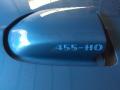
I have gotten a couple requests for photos of the super rare, Formula 455HO Ram Air, air cleaner, so here you go:
One interesting thing I noticed is that these were dip painted originally. You can see the paint line inside the two snorkels, where the air pocket kept the paint out. (The Formula 455HO air cleaner had two heat risers and the Formula 400 had only one.)    
|
|
#6
10-14-2012, 02:40 PM
|
||||
|
||||
|
Re: The New Project: Part Deux!
Got the windshield in for the second time...
The first date coded windshield that arrived from Pilkington Glass had some issues. The date code was supposed to be flipped but it was readable from the outside, and there were a couple scratches in the glass that looked to be from the rack they must have been stored on. Pilkington was very attentive and immediately shipped out a second one. I can't say enough about Bob at Finishline Auto Glass in Hackettstown, NJ (908) 399-6461. He came out to the house three times - first to remove the original glass so I could clean up any possible rust issues (none found), then several days later to install the first windshield. (The scratches weren't visible until after it was installed), and then a thrd time to carefully remove the first new windshield so it could be shipped back, and then to install the second one. Extremely nerve-wracking to watch, but he is a professional and made it look easy. FYI: if you order date coded glass make sure you give them a photo of your existing code if possible. The date codes were put on in a variety of ways and positions - the most important of which is where are you standing when you are reading the date code: is it read from the outside of the car, or read from the inside like mine. Here's the original date code: And the date code on the second windshield:  And the finsh installation photos:  
|
|
#7
10-16-2012, 08:34 PM
|
||||
|
||||
|
Re: The New Project: Part Deux!
Now that the windshield is so clear, I got tired of looking at the degraded mirror glass on the rear view mirror and decided to do something about. After reading a variety of threads, I found that he best way to remove the glass was to soak the mirror in very hot water for 15 minutes. By then, the plastic/rubber gasket is semi-pliable.
I used my thumb and was able to work my way around the gasket several times, each time prying a little further so as not to crack the glass since it is glued to the backing of the gasket. Eventually, I was able to get the edge of a plastic decal applicator squeegee under the lip and gradually moved it around the perimeter, each time pushing a little farther in. Every few minutes I would soak it back in the hot water. This worked great. The glass just popped out. I was checking on prices for resilvering the existing glass but found that Paragon Corvettes sells the new mirror glass for 67-73 GM cars for $40 which is comparable to resilvering the old one. It is due to arrive tomorrow and we will see how it fits. https://www.paragoncorvette.com/p-35...ror-glass.aspx Here is the original 1972 black pebble grained mirror.  After the glass was removed. The white is the residue where the glue pulled off the silvering from the rear of the mirror:  The only logo I could find on the mirror was a "GM" at the top of the gasket:  Nothing at the bottom: 
|
|
|
|




 Hybrid Mode
