
Dedicated to the Promotion and Preservation of American Muscle Cars, Dealer built Supercars and COPO cars. |
|
|
|
#1
 05-05-2010, 12:06 AM
|
|||
|
|||
 Re: 68 Yenco clone
Kurt,
Ok then let me ask this, were they even designated 4 bolt blocks, I remember that there was an LS6 cam that was about 520 lift and I think that also came in the L88. So then, did an L88 just come in the Corvette ??? Cheers: auschris 
|
|
#2
05-05-2010, 01:17 AM
|
|||
|
|||
|
Re: 68 Yenco clone
I suspect you'll be looking for a four bolt block. The L88 in the first design configuration is a long way away from the L72 and the second design L88 is even further away (more radical). I think though in your own best interests, it might be good to start gathering printed info (books, magazines, etc.) on these cars and other Chevrolets of the era. Even though I do this for a living, I'd really suggest you dig deeply into the research part of the equation first (just like teachers I guess -- in reference to one of your earlier comments). If you're determined to build an accurate clone, there's still a rather steep learning curve that is likely going to be far greater than a few questions and answers posted here.
Best of luck. Wayne [img]<<GRAEMLIN_URL>>/smile.gif[/img]
|
|
#3
05-05-2010, 02:42 AM
|
|||
|
|||
|
Re: 68 Yenco clone
Wayne,
I am learning this very quickly, it is not so cut and dried as I first thought. My thanks go to you and the others that have posted this has helped me a lot. So what you are saying is that the L72 is a plain jane 427, cast oval port heads and not even a guarantee of a 4 bolt block or a steel crank?? Can I ask, in your opinion what would be the main points to look for in a Camaro Yenko clone.
|
|
#4
05-05-2010, 03:03 AM
|
|||
|
|||
|
Re: 68 Yenco clone
Uhm. No. I didn't say that (and no else did either as far as I can see). The L72 is a rectangular port, 11:1 forged piston, 4-bolt main, steel crank, 3/8-inch rod bolt, mechanical cam, high rise aluminum intake, Holley carburetor engine combination. It saw service from 1966 to 1969 inclusive. It was far from plain jane. It was the workhorse high performance big block of the era. And from most accounts (and personal experiences of mine and countless other old "farts" like me [img]<<GRAEMLIN_URL>>/wink.gif[/img] here), it did pretty good for itself on both the street and the track....and still does in plenty of cases. In other words, you're pretty much dealing with the backbone (or dare I say, the "Holy Grail"
 of Chevy high performance in the sixties. of Chevy high performance in the sixties.There are too many components and variables to get into to provide you with a handful of points to look for. With that said, you really need to know what exactly the L72 was, what a SS396 was all about, what Yenko accomplished and take it from there. To understand these cars, you have to gather as much printed data as possible, then ask about the little details. Start looking for books my friend. There's plenty out there (some good....some not so good). I hope that helps. Wayne
|
|
#5
05-05-2010, 03:57 AM
|
|||
|
|||
|
Re: 68 Yenco clone
Wayne,
This has been most entertaining and yes I will go hit the books as I do want to learn. Back in the day (as I class myself as a young old fart) I ran a blown BBC sedan and my favorite combo was a 427 steel crank in a truck block with 4.375 bore and 10.5 pistons with a 1471 fuel blower and rectangle iron heads.made about 1200 hp on a good day. Cheers: auschris ps: so the main difference between a L78 and a L88 was 7/16 rods and aluminum heads
|
|
#6
05-05-2010, 04:39 AM
|
||||
|
||||
|
Re: 68 Yenco clone
<div class="ubbcode-block"><div class="ubbcode-header">Originally Posted By: auschris001</div><div class="ubbcode-body">so the main difference between a L78 and a L88 was 7/16 rods and aluminum heads </div></div>
Chris, the L88 had aluminum heads and the L72 had iron heads. The intakes were similar. Both were dual plane but the L88 had the divider cut down a little where the L72's divider wasn't altered at all. I'm sure someone has pictures of the two.
__________________
 1969 SS396 Post Sedan Delivered to Van-T Topeka KS MCACN Day2 Concourse Gold Award 1965 VW El Lobo Dune Buggy built in the mid 70’s for the Iowa Shriners 1968 Schwinn Orange Krate 1969 Schwinn Pea Picker 1968 Schwinn 5-Speed 1970 Schwinn 3-Speed Deluxe 1972 Schwinn 10-Speed Continental 1973 Schwinn 5-Speed Suburban All Original Paint Bikes
|
|
#7
05-05-2010, 04:39 AM
|
|||
|
|||
|
Re: 68 Yenco clone
The L78 was a 396. The L72 was a 427. And so was the L88. The first design L88 used a closed chamber 12:1+ piston with a matching aluminum head; second design had an open chamber 12:1+ piston with a matching aluminum head. L88 cams were different (considerably more aggressive) than L72's. Carbs were larger. Intake was the same, but the divider was milled. Different oil pump. Larger diameter pushrods and a few other details. Tell you what: Try going to this site:
http://www.nhra.com/competition/blueprints.aspx You can download basic blueprint specs on the engines, as they apply to NHRA (class) drag racing. It's not the ultimate source, but it'll give you a toe-hold on the info. [img]<<GRAEMLIN_URL>>/grin.gif[/img] Take care... Wayne
|
|
#8
05-05-2010, 04:03 PM
|
|||
|
|||
|
Re: 68 Yenco clone
Wayne,
Thanks again for the help, I used to have a bunch of books and I am just going from fading memories. So did a 68 Yenko Camaro come with an L88 as well as a L72 and my understanding is that the L72 had cast heads right??? I hope it's not a sin but if I get bogged down in detailed parts I will never get this done, but if I can avoid things like having alloy heads where they should be steel or the wrong air cleaner, things that are obvious I will be happy. I will do this car to the best of my ability making it a kinda tribute to Yenko.
|
|
#9
05-05-2010, 03:17 AM
|
||||
|
||||
Re: 68 Yenco clone
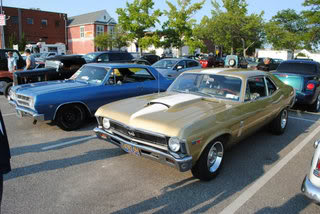
 more pics of this....creation? [img]<<GRAEMLIN_URL>>/dunno.gif[/img] [img]<<GRAEMLIN_URL>>/biggthumpup.gif[/img]
|
|
#10
05-05-2010, 04:00 AM
|
|||
|
|||
|
Re: 68 Yenco clone
Yep have more pics but need to resize them down like my Camaro pics.
it has an intercooled turbocharged 427 and a glide
|
 |
| Thread Tools | |
| Display Modes | |
|
|







 Hybrid Mode
